Wedding Planning Guide: How to Plan a Wedding, Step by Step
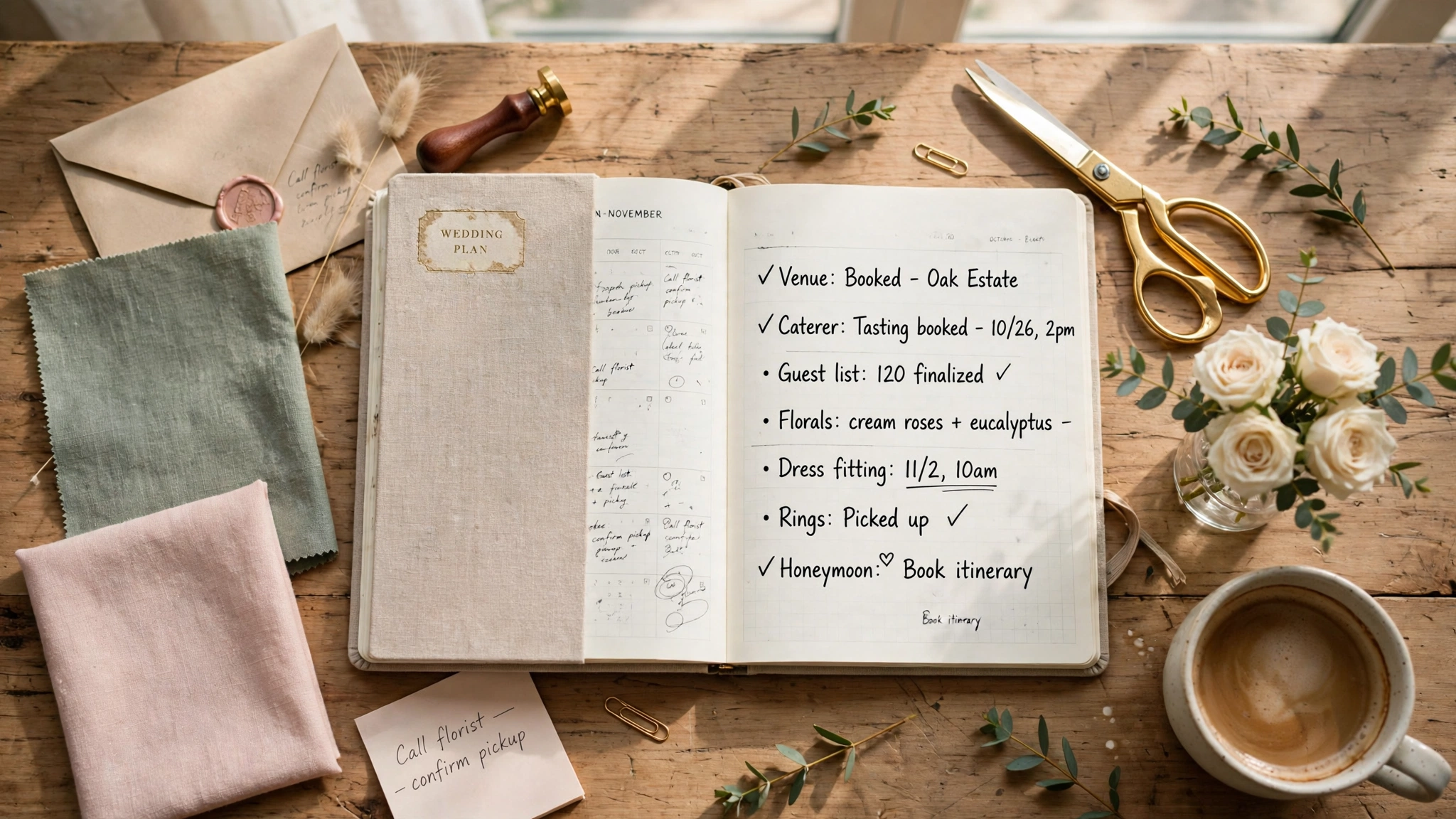
Every wedding is planned in the same order, whether the couple knows it or not. The calm weddings are the ones where the big decisions were made early and in sequence, so each choice quietly narrowed the next. The frantic ones are almost always the ones where a small decision was made before a large one — invitations ordered before the venue confirmed its capacity, a dress bought before anyone asked whether the ceremony was on grass.
This guide is that order, from the week you get engaged to the morning of the wedding itself. At each step there is a link to the detailed Blush & Borrowed tool for that stage — the checklist, the budget breakdown, the venue questions, the day-of timeline. Work through the steps in sequence and the planning mostly manages itself.
Before anything: the four decisions that come first
Four decisions, made in one honest evening, will quietly govern the next year of planning. Priorities: each of you names the three parts of the wedding you care about most — the food, the photos, the party, the room itself. Budget: a single total you can genuinely spend, agreed between you and anyone contributing. Guest count: not the list yet, just the number, to within twenty. Date window: a season and a preferred month, with some flexibility if you can manage it.
Notice what is not on that list: colours, dresses, flowers, cakes. Those are the fun decisions, and they are all downstream. Couples who make the four big decisions first find the fun ones easy; couples who start with the fun ones often have to remake them.
Step 1: Set the budget — and let it be a priority list
The budget is not a punishment; it is the written form of your priorities. The proportions of a wedding budget barely change from country to country: venue, catering and drinks take around 40%, photography and video about 12%, attire around 10%, flowers and decor about 9%, and a contingency of roughly 7% that you protect until the final month. Our wedding budget breakdown shows the full split at three budget sizes, the costs couples always forget — alterations, vendor meals, postage, the morning after — and the safest places to save without the day looking cheaper.
For context on totals: The Knot's 2026 Real Weddings Study puts the US average at $34,200 for about 117 guests, while the median wedding costs closer to $24,000 — a minority of very large weddings pull the average up. Read averages as weather reports, not instructions. Your number is the one you set in that first conversation.
Step 2: Book the venue — the decision that fixes the date
With a budget and a rough guest count, the venue comes next, because it fixes your date, your capacity and often your caterer in a single signature. Popular venues in the US, UK, Canada and Australia book 12–18 months out for peak Saturdays, so this is the step where the calendar matters most.
Tour with your eyes open and a list in hand. Capacity with tables and a dance floor is a different number from the one in the brochure; curfews, corkage, wet-weather plans, supplier restrictions and the payment schedule all hide in the details. Our guide to the questions to ask a wedding venue before you book lists the 25 that matter, grouped the way they come up on a tour — ask them before you fall in love with the room, and get the answers in the contract, not just in conversation.
Step 3: Book the vendors who sell out
After the venue, book in order of scarcity. Photographers and videographers go first — the good ones take one wedding per date and book a year out, and theirs is the only product you keep for decades. Then catering (if the venue does not provide it), the band or DJ, and your officiant or registrar — and check your area's legal notice period for marriage, which can run from days to months and occasionally catches couples out.
Florist, cake maker, hair and makeup, transport and ceremony musicians follow over the next months. None of this needs to happen in a panic: it needs to happen in order, which is what a checklist is for.
And the paperwork: boring, early, non-negotiable
Somewhere alongside the vendor bookings sits the least romantic and most immovable part of planning: the legal paperwork. Every country — and often every state, province or county within it — has its own rules for marriage licences, notice periods and who may legally marry you. In some places the licence takes an afternoon; in others, notice must be given months ahead, and religious ceremonies carry their own preparation requirements. Check your local rules the month you get engaged, write the deadlines into the checklist next to the dress fittings and cake tastings, and treat them with the same seriousness. It is the one part of a wedding that cannot be improvised at the last minute, and the couples it catches out are always the ones who assumed it would be simple.
Step 4: Run the whole thing on one checklist
A wedding is a few hundred small tasks with deadlines set by other people's calendars. The couples who stay calm keep them in one place, in date order, and work a little at a time — most find a short weekly planning session (thirty minutes, same time each week) beats occasional all-day marathons, and keeps wedding talk from swallowing every evening.
Our 12-month wedding planning checklist is the month-by-month version of this guide: what to book, buy and decide at 12 months out, at 9, at 6, at 3, and in the final week — including a fast-track that compresses it into six months. If you read nothing else, read that and this page; between them they are the whole system.
Step 5: Decide the look — palette, decor, details
Only now — venue booked, vendors falling into place — does the look get decided, around 6–5 months out. Palette first, because it drives flowers, linens, stationery and cake; then the ceremony backdrop, the tables, the centrepieces and the details layer. Our wedding decor ideas guide walks through that order in full, from choosing between a soft sage-and-blush palette and a moody plum-and-olive one, to making a small decor budget look generous with greenery and candlelight.
This is also when the dress and wedding-party outfits are usually ordered (many gowns take 6–9 months to arrive and alter), invitations are designed, and the registry is built. Style decisions feel big, but with the structure underneath them settled, they are the most enjoyable part of the whole process.
Step 6: Consider the small wedding — a real option, not a compromise
Somewhere in the guest-list conversation, many couples discover they would genuinely prefer a smaller day. A micro wedding — usually 10 to 30 guests — is not a cut-down wedding; it is a different shape of one, where the same budget buys a better meal, a more beautiful room and time with every single guest. Restaurant private rooms, gardens, rented houses and courthouses all become venues at that size.
If that idea keeps coming back, our micro wedding ideas guide covers what counts as micro, the upgrades a small guest list lets you afford, and how to handle the conversations with people who are not on the list. Small weddings also plan faster — the same steps in this guide, with a shorter guest-list chapter.
Step 7: Plan the day itself, hour by hour
A month or so before the wedding, turn the plan into a schedule: who needs to be where, at what time, holding what. Getting ready, first look and portraits, the ceremony, cocktail hour, dinner, speeches, first dance, the last song — each block has a natural length, and the day runs late far more easily than it runs early, so buffers go around travel and transitions.
Our wedding day timeline gives a complete worked example for a 3 PM ceremony — every block timed, from hair and makeup to the send-off — plus how to shift it for morning and evening ceremonies and how long each part really takes. Share the finished version with every vendor and the wedding party; on the day, your only job is to be in it, not to run it.
Step 8: The final month — confirm, delegate, stop
The last month is for confirmations, not new ideas. Final numbers to the venue and caterer. Arrival times and balances confirmed with every vendor, in writing. Place cards printed, emergency kit packed, and every job on the day delegated to a named person — one for vendor questions, one for the rings, one for the marriage certificate. Then stop adding things. The wedding you have planned is the wedding; the final week's task is simply to arrive at it rested.
The one-sentence version: budget, guests, venue, vendors, checklist, look, timeline — in that order. Almost every planning horror story is one of those words happening in the wrong place.
All our planning guides
Every planning tool on Blush & Borrowed, in the order this guide uses them. Updated as new guides are published:
- Wedding Budget Breakdown: Where the Money Actually Goes — percentage splits for three budget sizes, forgotten costs, safe savings.
- 25 Questions to Ask Your Wedding Venue Before You Book — capacity, costs, curfews and the small print, asked before you sign.
- The 12-Month Wedding Planning Checklist — every task in date order, plus the six-month fast-track.
- Small Wedding, Big Love: 15 Micro-Wedding Ideas — for under 30 guests: venues, upgrades and the guest-list conversations.
- Wedding Day Timeline: A 3 PM Ceremony Sample Schedule — the whole day, hour by hour, with timings for every block.
Frequently asked questions
Where do I start when planning a wedding?
With one conversation: priorities, budget, rough guest count, date window. Everything else — venue, vendors, style — is booked around those four decisions, in that order.
How long does it take to plan a wedding?
Typically 12–15 months, driven by venue and photographer availability for peak dates. Six months is entirely workable with the fast-track in our checklist; small weddings can come together faster still.
How much does a wedding cost?
The Knot's 2026 study averages $34,200 in the US (median ≈ $24,000); Zola's 2026 average is $36,000. Guest count, city and day of the week move the total more than anything else — and your budget, not the average, is the number that matters.
Do I need a wedding planner?
Not necessarily. Options range from a full planner to a month-of coordinator to doing it yourselves with a checklist and a named person running the day. Small weddings and venues with their own coordinators often need no outside planner at all.
When should I book the venue?
As soon as budget and guest count are roughly set — 12–18 months ahead for peak-season Saturdays. It fixes the date and capacity that everything else depends on.
Start with the checklist
Every task in this guide, in date order, month by month — print it, pin it, tick it off.
Open the 12-month checklist